Help Your Small Business Team Thrive with Organization and Structure
A vital part of your success lies in creating a file organization system and ensuring your entire team adheres to it.
It never ceases to amaze me how some of the business practices that make the biggest difference are also the most foundational. However, many of them are also the easiest to overlook. One of these, file organization structure, tends to be the thing that creates the biggest problems for small business owners and their teams.
Whether you’re starting your business from scratch or own a multi-million dollar company, a file organization system is vital to productivity, profitability and creating an environment where your team thrives.
That advice may seem basic or it may seem profound, depending on your point of view. Think about it, though: how often have you…
- Silently (or not so silently) gotten frustrated because you can’t find a resource when you need it?
- Dealt with the distraction of helping an employee find something that should be easy to access?
- Found that multiple team members duplicated each other’s work (and therefore their payroll) because they had no idea something was completed?
If you can relate to any of these, you’re not alone. Building a file organization structure that fits your needs does take some work on the front end, but it’s definitely worth it down the line.
Whether you’re a new business owner or are trying to fix a messy file structure, I want to share some tips to get you started.
Tiers of Organization
This process starts with recognizing that there are different organizational schematics that need to be in place for different areas of your business.
Think of it in layers or tiers.
The first tier is the overarching umbrella of how you want things to work in general. This is where your company’s systems manual will come in handy. A good table of contents can help you lay out protocols for using equipment and software, communications with clients, team communications, and general information on how to interact as a team and work together. This schematic is often found in a General Systems Manual, and it is usually the first thing a new hire will read when they onboard.
The second tier of organization relates to Day to Day Operations by Department. These will relate to repeatable tasks and day-to-day responsibilities. This is where you might have different departmental systems manuals.
For example, if the person works on the Marketing Team, they will be utilizing the Marketing Systems Manual. If their job is specialized within that department, they may have a smaller manual that lays out their daily and weekly tasks (like social media, copywriting, graphic design, or video editing), to show them how things are done and how they fit into the larger structure.
If they’re on the Technical Team (i.e., the legal team, dental team, surgical team, audio installation team, etc.), they will have their own manual to show them how each of their tasks should be done. For example, in a law firm, the general mechanisms of how we file something with the court or with an agency would be in this second tier.
The third tier will be the Organization by Service or Product. This is where you would find the actual streamlined workflows with policies, procedures, checklists, templates, examples, scripts, videos, diagrams, etc. These are the items you’ll utilize to help train up your team on how to do specific tasks related to what you do as a company.
As an example, while the general mechanisms of filing a document with the court would be in the second tier, how to actually draft a motion, including the contents and arguments to be made within that motion, would actually be made in the third tier.
The fourth tier is how you organize your client’s information so the team can quickly find what they need and proceed forward without any unnecessary waste.
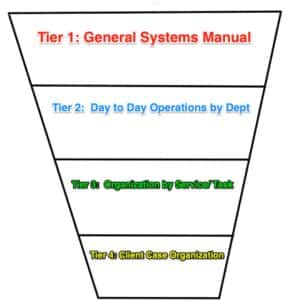
This hierarchy isn’t meant to make the process complicated, but to help us stay organized from the high-level 10,000-foot view down the “boots on the ground” 1,000 foot view.
Putting Your Organization Structure Into Action
You might think that this process would be obvious to everyone – and on some level, it is. We all have organizational methods that make sense to us.
The problems often start when the owner isn’t clear about which organizational structure to use and how to implement it. When clarity isn’t given on this up front, each person will inherently use the methods that make sense to them, and usually, a bit of chaos will ensue.
This is why it’s so important to create systems manuals for your business. They can be light at first – just the overall structures and examples for your team to follow as it grows. As your business (and your team) expands, you can refine these manuals to be more detailed. And the great news? Your team can help you do it!
One method that we find to be helpful is to include having a new hire suggest revisions to the manual during their onboarding period and first few months working with us. This isn’t done to put pressure on them, but to get a fresh perspective on what makes sense to a brand-new team member.
Another option is to include submitting a new or revised addition to the departmental or positional manual each week from various employees. This is something we require from our Admin, Marketing, and Support Team members, and it has done a lot to help us keep our manuals current. Doing this not only takes some of the work off you, it also gives automatic buy-in from your team. They’re much more likely to implement what they help create!
Whether you’re starting to put your organization structure together or refining what you have previously built, just remember: put a plan in place and then, just get started. If we can help you implement, just let us know!